Dashboard

E-Commentary


Sponsored
joined 4 years, 10 months ago
No image

Aurawomen

Best IVF Centrs in Pune 2021 |Aurawomen.in
Directory:
Expertise:

In vitro fertilization (IVF) is a complex series of procedures used to help with fertility or prevent genetic problems and assist with the conception of a child.During IVF, mature eggs are collected (retrieved) from ovaries and fertilized by sperm in a lab. Then the fertilized egg (embryo) or eggs (embryos) are transferred to a uterus. One full cycle of IVF takes about three weeks. Sometimes these steps are split into different parts and the process can take longer.IVF is the most effective form of assisted reproductive technology. The procedure can be done using your own eggs and your partner’s sperm.In this Article will Find the best IVF Centres in Pune, with high success rates, low cost IVF treatment, IVF doctors, or best Experience doctors and centres according to best Service provided by the Centre.


view this profile
joined 4 years, 10 months ago
No image

Surrogacy treatment

Top Surrogacy Centres in Patiala | Low Cost Vinsfertility
Directory:
Expertise:

Surrogacy centres in Patiala offer premium administrations to the intended guardians just as the proxy mother. The system is performed by gifted trained professionals, who have long periods of involvement. It is additionally ensured that the proxy mother is very much experienced and guards the unborn youngster. Surrogacy may appear to be a generally new cycle at the same time, indeed it has been existing since the scriptural occasions. Since then, at that point, the headway in this challenging yet fulfilling strength of surrogacy measure has made it workable for some intended guardians to satisfy their fantasies of parenthood. For information Please Contact at 919643264509


view this profile
  • Over the past 2 decades minimally invasive surgery and computer assisted navigation (CAN) systems have significantly changed spine surgery
  • Minimally invasive spine surgery (MISS) has become a significant subspeciality accounting for ~50% of all spine surgeries undertaken in the US
  • Together MISS and CAN systems promise enhanced precision, improved outcomes, and lower costs
  • CAN systems provide surgeons with improved visibility of the operating site, but emit hazardous radiation that can cause cancer
  • Spine surgery appears to be winning the challenge to increase the development of minimally invasive surgery while decreasing harmful radiation in the operating room
  • MISS is positioned to grow and increase its market share but faces some headwinds
 
- Low back pain and the global spine industry - 
 
Minimally invasive spine surgery and computer assisted navigation systems
 
Minimally invasive spine surgery (MISS) requires only a small incision and uses specialized instruments and techniques that minimize cutting and results in minimal damage of body tissue. The technique serves the increasing prevalence of degenerative spinal disorders, attributed to sedentary lifestyles of aging populations, which have helped to drive the growth of a global spinal implants and devices market. In addition to the increased availability of biologics and customizable implants and the refinement of operative techniques, the development of MISS has been supported by advances in imaging and navigation technologies that make surgical targets virtual on a monitor to improve the accuracy and precision of surgical interventions. Today, there is a growing body of research demonstrating MISS’s advantages over the traditional open approach.  However, computer assisted navigation (CAN) systems tend to emit harmful ionizing radiation that can cause cancer. Reducing radiation in the OR while improving the quality of image guidance is expected to fuel further growth of MISS.
 
 In this Commentary

This Commentary focuses on minimally invasive spine surgery and computer assisted navigation systems. Two technologies, which have changed the landscape of modern spine surgery and offer potential benefits for both patients and surgeons. Has MISS reached its market saturation? If not, what will affect the speed and extent of its further adoption? 
 
Minimally invasive and open spine surgery

Over the past 2 decades, MISS has become a significant subspeciality and currently accounts for ~50% of all spine surgeries undertaken in the US. It is positioned to increase its influence over the next decade but faces some headwinds.

As a general principle, it is preferable to intrude as little as possible when carrying out a surgical procedure to minimise damage to surrounding tissue and to speed up recovery time. Many spine procedures that once required invasive operations (open surgery) have been replaced with MISS techniques.

Open spine surgery typically involves relatively long incisions down the back to give the surgeon the best view of, and access to, the anatomy. During such procedures, it is sometimes necessary to cut through and move aside muscles and tendons to reach the affected area, which can cause damage to these tissues and prolong recovery.

In MISS the surgeon makes a small incision and then inserts a device called a tubular retractor, a stiff, tube-shaped tool that creates a tunnel to the problem area of the spine by gently pushing aside the muscle and soft tissue around the affected area. The surgeon can then put small tools through the tunnel to work on the spine and use a special microscope to view real-time X-ray images of the spine. This approach results in less damage to the muscles and soft tissues that surround the spine, which leads to a more expedited recovery.

MISS has gained popularity both with patients and clinicians and has become increasingly feasible for the management of a range of spinal disorders. Progress has been made in the development of a direct lateral approach [from the side] as well as improvements of tubular retractors. Common spine surgery treatments available through minimally invasive methods include degenerative disc disorders, herniated discs, lumbar spinal stenosis, spinal deformities such as scoliosis, spinal infections, spinal instability including spondylolisthesis, vertebral compression fractures, and spinal tumours. In 2020, MISS procedures accounted for ~50% of all spine surgeries performed in the US, which had increased from ~16% in 2012.

According to David Bell, a consultant neurosurgeon at King’s College Hospital, London, who specialises in complex spine surgery, MISS significantly improves the patient experience by, “reducing the size of the incision and the amount of tissue manipulation . . .  It also minimises post-operative discomfort, cuts infection rates, lessens blood loss and reduces a patient’s recuperation time”. See video below.
 
 
The evidence

There is a growing body of research to support the benefits of MISS, which include: (i) reduced trauma to muscles and soft tissue, (ii) better cosmetic results from smaller incisions, (iii) less blood loss, (iv) reduced risk of infection, (v) faster recovery time and less rehabilitation, (vi) diminished reliance on pain medications, and (vii) reduced hospital stays. A further perceived benefit is the increasing range of MISS undertaken in outpatient settings. Such benefits are likely to fuel the refinement of surgical techniques based on patient outcomes, and lead to the growth of MISS.
 
However, not all studies are so positive about the benefits of MISS. A 2017 review of 17 randomized controlled trials, which compared MISS against open procedures for three common disorders, concluded that, “the evidence do not support MISS over open surgery for cervical or lumbar disc herniation”. The study suggests that there were some advantages for transforaminal lumbar interbody fusion (TLIF), [a procedure that melds the front and back sections of the spine through a posterior approach], but “at the cost of higher revision rates, higher readmission rates and more than twice the amount of intraoperative fluoroscopy”. [an imaging technique employed to improve intraoperative visualization of the operating field, which emits hazardous radiation]. The study concludes that, “Regardless of patient indication, MISS exposes the surgeon to significantly more radiation”. 

Two papers published in the January 2020 edition of the Journal of Spine Surgery report on a global survey of 430 surgeons to assess the extent of MISS and the training surgeons receive. The response rate was significant at 67%. 33% of respondents were neurosurgeons, 55% orthopaedic surgeons and 12% were surgeons with other postgraduate training. One research paper concludes that, “endoscopic spinal surgery is now the most commonly performed MISS technique”, and the other suggests that, “very few MISS surgeons are fellowship trained but attend workshops and various meetings suggesting that many of them are self-thought. Orthopaedic surgeons were more likely to implement endoscopic spinal surgery into the routine clinical practice”.
A review of the state of MISS reported in the June 2019 edition of the Journal of Spine Surgery confirms MISS as a significant subspeciality, “evidenced by the large and constantly growing body of literature on this topic”, and driven by “significant advancements in imaging and navigation technologies, refinement of operative techniques, availability of biologics and customizable implants, and most importantly, evidence of feasibility, efficacy, safety and value, compared to traditional approaches as demonstrated by the current literature”.
You might also like:

If spine surgery fails to relieve low back pain why is it increasing?


Unmistakably, over the past two decades, MISS has become increasingly feasible, efficient, and popular. An important question is, how fast is MISS advancing? There is a paucity of research, which addresses this question. However, a global survey of spine surgeons published in the January 2020 edition of the Journal of Spine Surgery provides some insights. Findings suggest there are regional variations in the acceptance and utilization of MISS. The study surveyed 586 spine surgeons in 5 major regions of the world, which yielded 292 usuable responses: a significant response rate of ~50%. 70% of spine surgeons in Asia and South America thought MISS was accepted into mainstream spinal surgery in their practice areas compared to 63% of spine surgeons in North America, 53% in Europe and 50% in Africa & the Middle East. The percentage of spine surgeons that reported using MISS was higher: Asia (97%), Europe and South America (89%), and Africa & the Middle East (88%). Surgeons in North America reported the lowest rate of MISS implementation globally.  
 
Although innovations and techniques in MISS have continued to develop over the past decade, a significant percentage (~50% in the US) of surgeons are understood to use open surgical techniques. Reasons for this include: (i) lack of adequate surgeon training and experience, (ii) the steep learning curve needed for MISS, (iii) inadequate hospital resources and (iv) the patchiness of research on the benefits of MISS. It seems reasonable to suggest that such factors affect the adoption rate of MISS. But perhaps the most significant factor influencing the speed of its adoption will be the rate of development of robotic surgical systems. An understanding of the impact of these factors will help producers hone their strategies and business models.
 
Computer assisted navigation systems

A common therapy to correct spinal disorders is fusion, which melds together two or more vertebrae so that they heal into a single, solid bone. Spinal fusion surgeries use implants of biocompatible materials, such as titanium, as well as rods, plates, screws, and interbody cages and account for the largest segment of the global spine market.
You might also like: 

Low back pain, spine surgery and market shifts

During spinal fusion procedures, pedicle screws are used for spinal fixation, stability, and fusion. The incorporation of such screws into spine surgery in the early 1960s was a significant advance because it offered stability and decreased rates of pseudarthrosis [failure of a fractured bone to heal] compared to previous methods. However, subsequent studies suggested that there was a percentage of pedicle screws inaccurately placed, which could harm adjacent structures and potentially have mechanical, neurological, and vascular consequences for patients.
Image guidance systems were a noteworthy development in spine surgery to reduce the morbidity associated with the mispositioning of pedicle screws and today such systems are used widely. Fluoroscopy, an early guidance method, provided real-time X-ray imaging for guiding interventional procedures, which resulted in more accurate placement of screws, but such systems emitted hazardous ionizing radiation that surgeons, patients, and OR staff were subjected to. Any spine surgery that is visualized with fluoroscopy can involve 10 to 12X higher amounts of radiation from the use of X-rays compared to non-surgical procedures. Compared to a hip surgeon, a spine surgeon can experience 50X more harmful emissions over the course of a professional career and this has been linked to the development of cancers. Reducing radiation exposure is an important challenge.
 
Guided systems and reduced radiation

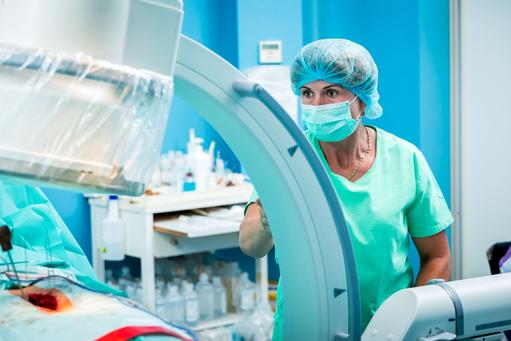
Newer intraoperative navigation modalities have been found to reduce radiation exposure significantly compared to traditional fluoroscopic guided percutaneous surgical techniques, and have become an important addition in spine surgery. Real-time image guidance, along with continuous computation and scan integration by the navigation system, allows a surgeon to visualize a comprehensive 3D picture of the operating site. Intraoperative computerized tomography (CT) scans [the use of X-rays and a computer to create detailed images of the operating site], together with infrared and other optical guidance technologies have substantially increased the accuracy and precision of spine surgeons to place pedicle screws. 
 
One such enhanced guidance system is ultralow radiation imaging (ULRI) coupled with image enhancement and instrument tracking (IE/IT). This is a new image modifier that allows a computer to show real-time movement of an instrument as it is adjusted, mimicking live fluoroscopy, but without continuous radiation production. Recent research suggests that ULRI-IE/IT systems, “can dramatically reduce radiation output and the number of images acquired and time needed to perform fluoroscopic procedures”. 
 
There are numerous FDA approved advanced CAN systems but let us briefly describe some popular ones. The Airo Mobile Intraoperative CT-based Spinal Navigation system was approved by the FDA in 2013, and developed by Brainlab, a privately held German MedTech company headquartered in Munich. The technology is one of the pioneers of advanced surgical navigation platforms and has many similarities to other CAN systems. It uses a mobile circular scanner attached to the operating table for 360° imaging, and a scanning stereotactic camera, which uses a set of three coordinates for instrument registration. Research published in the July 2018 edition of the Journal of Neurosurgery suggests that the Airo “mobile CT scanner reduced the rate of screw repositioning, which enhanced patient safety and diminished radiation exposure for patients, but it did not improve overall accuracy compared to that of a mobile 3D platform”.
 
Another popular system is Medtronic’s Stealth Station Spine Surgery Imaging and Surgical Navigation with O-arm, a portable imaging device that fits over the surgical table to take images of the operating field. This uses similar technology to Brainlab’s Airo, but opens at 90° to allow for mobilization around the patient. A third system is produced by Ziehm Imaging, another German company, which specializes in the development and manufacture of mobile C-arms [imaging devices that can be used flexibly in operating rooms]. In 2015, the company received FDA approval for the Ziehm Vision FD Vario 3D with NaviPort Integration. This is an intuitive technology, which obtains images via a 190° rotation with a C-arm around the patient and provides surgeons with, “crystal-clear and distortion-free 3D images for maximum intraoperative visualization of anatomical structures”. However, if its reference clamps are moved after the initial registration process, repeat CT scanning is required to re-register the clamps. Stryker’s SpineMask Tracker and SpineMap Software system overcome this problem by gluing its reference trackers to patients.
 
With the widespread use of CAN systems in spine surgery there is an increasing number of studies, which demonstrate the advantages of such technologies. For example, two large meta-analyses suggest that CAN systems significantly increase the accuracy of pedicle screw placement compared to freehand placement. Research also suggests that patients who undergo CAN pedicle screw placement have lower complication rates than those who undergo freehand placement.
 
Notwithstanding, findings of a global survey conducted in 2013 and reported in the September 2019 edition of The Spine Journal suggest that ~78% of surgeons still use two-dimensional fluoroscopy during spine surgery. Despite the improved accuracy and reduced radiation provided by advanced computer-assisted spine navigation systems. This could be associated with costs, prolonged operative times, and their cumbersome nature.
 
Machine-vision image guided surgery system

7D Surgical, a Toronto based company that develops advanced optical technologies, has sought to overcome challenges inherent in traditional CAN systems by developing a machine-vision image guided surgery platform, [FLASH™]. The technology employs a satellite-based global positioning system (GPS), to create a 3D image of a patient’s anatomy, and uses visible light coupled with machine-vision algorithms that eliminate exposure to intraoperative radiation. Other benefits of 7D’s system include its rapid set up time and its minimal workflow disturbance. The fact that its navigation camera is integrated into the surgical light, eliminates the need to stop surgery and position supplemental surgical equipment, thereby allowing for continuous access to the surgical field. Further, and unique to FLASH™, is the fact that its reference clamp can be repositioned, and images re-registered within ~20 seconds. This facilitates seamless clinical applicability and reverses many of the drawbacks of preceding navigation systems. In May 2021, SeaSpine, a Nasdaq traded spine company, announced the acquisition of 7D in a deal valued at US$110m. In July 2021 SeaSpine received FDA approval of 7D’s advanced guidance system for MISS.
 
Takeaways

Over the past two decades, MISS has had a significant impact and established itself as a subspeciality throughout the world. Although it is difficult to calculate, it appears that ~50% of spine surgeries could still be open procedures. This suggests that strategic questions facing producers include whether MISS will expand further, and if so, at what speed. This Commentary suggests some factors, which are likely to impede the adoption rate of MISS. However, perhaps the most significant challenge to MISS is not the prevalence of open surgery, but the rapid rise and adoption of robotic surgical systems. Research published in the January 2020 edition of the Journal of the American Medical Association on the trends in the adoption of robotic surgery concludes, “Hospitals that launched robotic surgery programs had a broad and immediate increase in the use of robotic surgery, which was associated with a decrease in traditional laparoscopic minimally invasive surgery”. Robotic surgical systems in spine surgery is the subject of a forthcoming Commentary.
view in full page
joined 4 years, 11 months ago

Victor Howard

Dentist In Sunny Isles

At Sunny Dental, we proudly offer cosmetic dentistry and restorative dentistry. Our dental clinic is equipped with the latest technologies necessary to provide advanced procedures while ensuring optimal comfort. We accept all major PPO insurances, please give us a call for your complimentary insurance verification. Sunny Dental is conveniently located in Sunny Isles Beach. Florida near Golden Beach, Surfside, and Aventura, Florida. We know how busy life can get which is why we offer late appointments. Book your dental appointment with Sunny Dental today.


view this profile
joined 4 years, 11 months ago

Vins Fertility

Top Surrogacy IVF, Centres in Faridabad Vinsfertility
Directory:
Expertise:

Surrogacy is offered by the best surrogacy center. These infertility places sort out everything that is required pre, post, and in the midst of the surrogacy interaction. There are various infertility clinics that additionally arrange convenience administrations for couples who are coming from different nations. It's anything but the Best IVF and Surrogacy centres in Faridabad. In urban areas like Faridabad, there is consistently a shortage of super expert places and medical services professionals. The following are the Top Surrogacy Centers in Faridabad with options to book an appointment.


view this profile
joined 4 years, 11 months ago

Sagar Soodh

Top IVF Centrs in Vadodara |Sneh hospital
Directory:
Expertise:

Vadodara is one of the fastest developing cities in Gujarat and India. It is known for its flyovers and cleanness. It's a business city so by default we see various types of IVF centers, ranging from being cost-effective to luxurious treatments. Sometimes right after the basic infertility consultations, doctors ask the couple to visit an IVF Center. Other than this, medical tourism has also increased in Vadodara due to its positive reviews. In this blog, you will be knowing more and more about IVF centers in Vadodara, the treatment, its cost, and the success rates in Vadodara.


What is IVF?


In-vitro-Fertilization (IVF) is common infertility treatment. First, the ovaries are stimulated to develop multiple follicles, within each one is an egg, by using “fertility drugs”. Ultrasound monitoring of follicle number and growth along with blood hormone levels determine when a single injection matures the eggs. Then the fertility doctor takes the eggs from the ovaries using a small needle, while the woman is under light anesthesia and fertilizes them with sperm in a specialized lab. After fertilization happens, the eggs are cultured and develop into embryos. Three to five days later, the specialist re-implants the embryos back into the uterus.


3 Best IVF Centers in Vadodara, Gujarat:

From the above, you might have got an idea about the treatment. We also explained to you the parameters we have taken to select the Top IVF centers in India. So below are the highly recommended Top IVF Centers in Vadodara.


Bliss IVF Fertility And Andrology Institute, Vadodara


Bliss IVF Fertility And Andrology Institute is the best IVF Center in Vadodara. This infertility center includes a huge number of fertility experts, qualified, and experienced infertility Specialists. Our IVF Clinic aims to provide the most advanced, competitive services of international standards at an affordable price and tries to help you by providing practical alternative solutions. With the help of world-class treatment facilities under one roof including the expertise of a young enthusiastic team of doctors supported by the finest technology from every corner of the world.


Sneh Hospital and IVF Centre, Vadodara


Sneh Hospital IVF Centre, Vadodara is one of the best infertility centers in Gujarat state, with easy accessibility through all routes of transport. Sneh IVF hospital is leading and certified ISO 9001:2008. The team of doctors of Sneh Hospital IVF Center in Vadodara has consulted and counseled 18,000 infertility patients in a year at our various centers and sub-centers across India. We are one of the unique centers all over India having a culture lab by international guidelines and standards.


Hera IVF Fertility Centre In Vadodara, Gujarat


Morpheus IVF is a prominent fertility centre, which trusts its technology and manpower to increase the chances of IVF success rates. Our prime objective is to provide the best quality treatment to patients that are suffering due to a variety of infertility issues. The centre offers very affordable costs and appreciates IVF success rates. Hera IVF Centre has sufficient caliber which can be seen to sustain itself in the market as a leader. The center has won the trust of numerous patients worldwide. The centre provides transparency in IVF treatment and infertility diagnosis. The infertility doctors employed by the Hera IVF have wide clinical experience in their respective fields of expertise.


Low Cost of IVF Treatment, Vadodara

The IVF cost of one session in Vadodara fluctuates from 1.5 lakh to 3 lakh excluding all the medications and injections. This is also not the final amount as many of the couples have already paid more than 5 to 6 lakh for the IVF treatment. The cost may fluctuate due to a lot of factors like your medical conditions, infertility issues, or you might need other treatment as well, etc. Keeping such things in mind you can anytime contact Vinsfertility experts to clear your doubts, we will assist you in offering precise information about the best low-cost IVF in Vadodara.


Best IVF Doctors in Vadodara, Gujarat

Dr. Nisarg Dharaiya


Dr. Nisarg Dharaiya is a leading Obstetrician, Gynaecologist, and Infertility Specialist in Vadodara, Gujarat. He has been practicing as an experienced doctor for more than a decade. He is an expert in infertility treatment and specializes in Intrauterine Insemination (IUI), In-Vitro Fertilization(IVF), and Pregnancy care. Dr. Nisarg Dharaiya has trained in many hospitals and institutions to get hands-on experience in infertility treatments. After gaining the experience, he established a fully-equipped clinic in Ahmedabad by the name of Sneh Hospital IVF Centre.


Dr. Mona Bhatt


Dr. Mona Bhatt is the best Gynecologist, Obstetrician and Infertility Specialist in Vadodara. She is an expert in the fields of Maternity, Infertility, Laparoscopy, Hysteroscopy, High-Risk Pregnancy Care, Aesthetic gynecology, IUI, IVF, ICSI, Gynecology and All Related Problems Care, etc. Dr. Mona Bhatt practices at Hera IVF Fertility Centre. Hera IVF Centre is equipped with the latest technology and capable of handling multiple advanced procedures related to Obstetrics, Gynecology, and infertility related issues. Dr. Mona Bhatt is a trustworthy, well-known, and one of the best IVF specialists in Vadodara.


view this profile
joined 4 years, 11 months ago

Dr Rajiv Ruwala

Figges Marsh Dental

Figges Marsh Dental Mitcham-based dental practice taken over in February 2016 by principal dentist Dr Ameeka Patel & Dr Rajiv Ruwala.

Best Dentist in Mitcham at Figges Marsh Dental are committed to providing patients with the best care, in a calming, welcoming environment.Figges Marsh Dental offers a wide range of cosmetic dentistry treatments ranging from discreet orthodontics such as Invisalign® to veneers and complete Smile Makeovers in Mitcham.

The excellent quality dental care and putting our patients’ interests first has recently helped us won the awards like ‘Best Dental Practice in Mitcham’ by Three Best Rated and finalists in the ‘Best Customer Service’ category in the Merton Business Awards 2019.


view this profile
joined 4 years, 11 months ago

Best Surrogacy Centre in Ahmedabad, Gujarat

Top 4 Best Surrogacy Centre in Ahmedabad, Gujarat Vinsfertility
Directory:
Expertise:

Surrogacy is a type of assisted reproductive technology (ART) where a lady (the substitute) offers to bring a child through pregnancy in the interest of someone else or a couple and then return the child to the intended parent whenever it is conceived. Surrogacy is a highly complex process, and there are numerous significant strides to guarantee that the two players settle on the best choices - including broad counseling, mental evaluation, and independent lawful guidance. Here you can find the rundown of the Top 4 Best Surrogacy Center in Ahmedabad, Gujarat with Surrogacy bundles, Success Rates, Services, and working fertility expert in Ahmedabad, Gujarat. The best surrogacy habitats in Ahmedabad are picked dependent on surrogacy achievement rates in Ahmedabad.


Flora Fertility Centre
Vani IVF Center, Ahmedabad
Wellspring IVF & Women’s Hospital
Sumiran Women’s Hospital & IVF center


view this profile
joined 4 years, 11 months ago

Ernest Galvan

Test Kits Tenders
Directory:
Expertise:

Yes We are also dealing in Test Kits Tenders , to helping medical industry and health sector in our country , we dealing in govt tender , public tender and private tender


view this profile
joined 4 years, 11 months ago

Kula Health

Kula Health

Community. Movement. Connection. Mindfulness. Happiness

We wanted to create a happy healing place. A place where people feel welcome, can switch off, and attend to their own needs with support from those dedicated to a holistic approach to healing.

We want to provide good guidance for health, plus pave the way to better lifestyles and human connections.

A place you’ll feel eager to come back to and it’s not just about Chiropractic or mindfulness – it’s about actively promoting happiness, healing, and wellbeing to all the members of our community.


view this profile